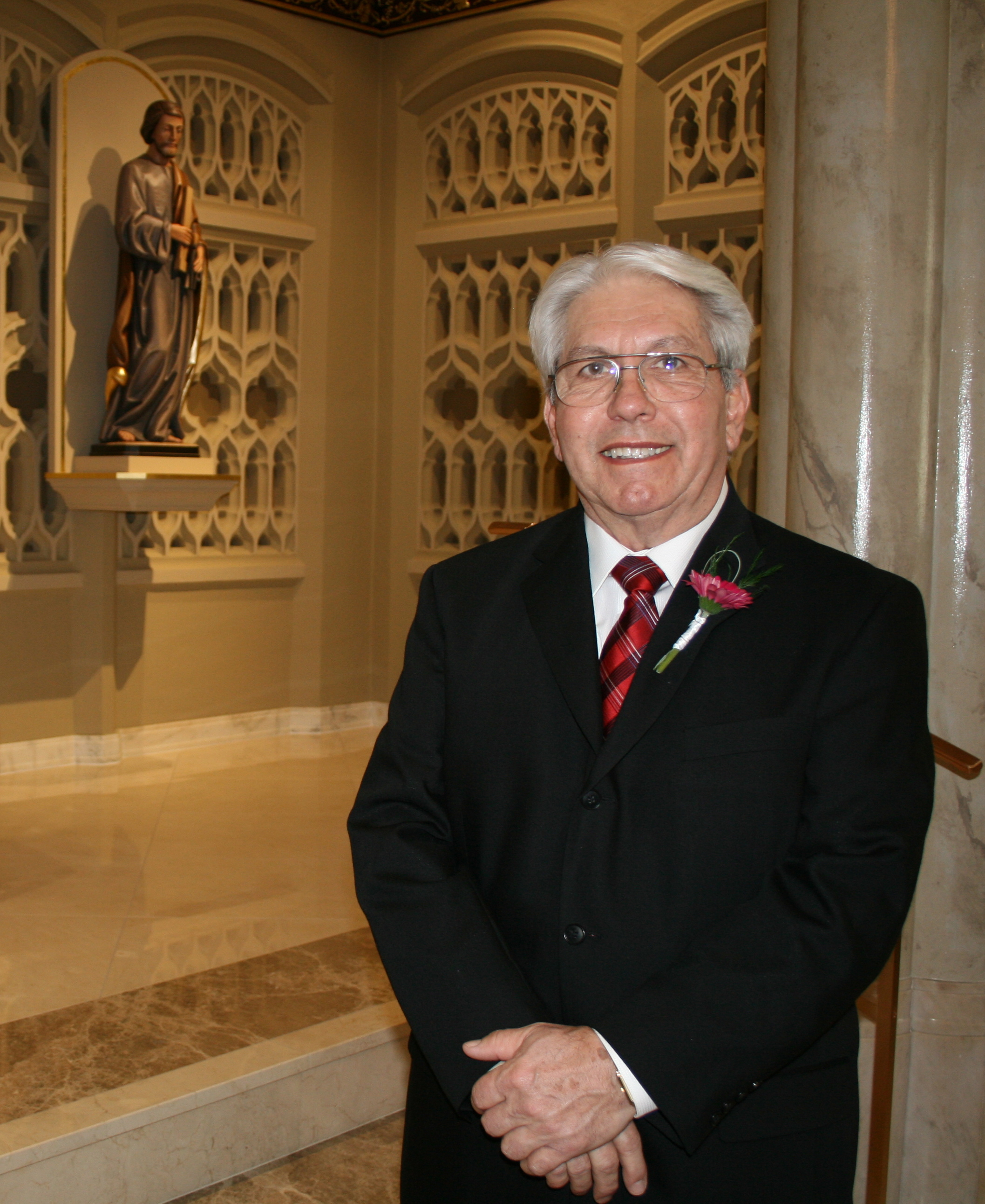
JimAndStJoseph

At my Dad’s funeral Mass, our family friend, Deacon Larry Antonsen, did a beautiful job of describing Dad’s effect on all of our lives. I was very honored by his celebration of Dad.

And my sister Christine gave a most thorough, delightful, and accurate description of who he was to all of us. It was him, coming out in our words, being described with the richness that he gave to us. Most fitting.

So below, as much for my own memory as to share with others, is the written tribute I shared in Dad’s Mass program.


Remembering

Love one another, as I have loved you.

By this everyone will know that you are mine, if you love one another.

I’m going to mention some commands from God, right out of scripture, and I guarantee you are going to see pictures in your mind, memories of things you’ve seen my father do.

For example, “Husbands, love your wives, just as Christ loved the church, giving himself up for her to make her holy, to make her blessed.” Need I say more than that?

How about, “A good name is better than great riches; to be esteemed, better than silver or gold.”

There is a name our father has given us. The name, “Carollo.” That name, his name, the name of Jim Carollo, is not a name on the outside, a label. That name courses through our blood, fills our spirit, and pours out in our actions.

My father is a man who loved us with his whole life. All of us.

“Love one another, as I have loved you. By this everyone will know that you are mine, if you love one another.” Christ commanded it of us, but I’m certain you can remember seeing my dad do it.

My father raised a family of strong-willed and strong-spoken people. To us who lived and worked with him, for a moment or a lifetime, I’m saying nothing new. He demonstrated this daily. And there’s no way you can confuse his boldness, his pushiness, with being selfish: his every action, every statement, was a deliberate act to show how he cared about you, no matter who you were.

When we are baptized, whenever we walk into church, we are using holy water and washing away who we were, and taking on a new name, the name God had given us: His name. We say, “In the name of the Father…” What is that name? It is character. It is caring. It is passion. It is love, acted out. With your whole life. That is Jim Carollo. In his last hours, I heard each of my brothers say that directly to him: “Dad, you have loved us with your whole life.”

What did Christ say? “Greater love has no one than this, that. He lay down his life for his friends.”

That is the name of the Father. That is the name he has given to us. And that is what you see when you remember the name Jim Carollo.

Jesus, speaking to his disciples, said, “Very truly I tell you, whoever believes in me will do the works I have been doing, and they will do even greater things than these.” If you spent any time working with my father, you know that’s what he called us to do.

There are thousands of stories, specific examples we each have, of the man we know, and now take time to remember.

If you worked for him, you know, he would stand up for you. If you worked beside him, you know he would give his all, because he cared. If you watched him, you saw complete follow-through to do what was right.  Whether it was something as trivial as his tools or or as significant as you, he made sure you were always taken care of, handled properly, and prepared, always at the ready for anything you faced.

Though forceful at times, and sometimes rough around the edges, I am certain that what you remember is his character, his love, his strength lived out and given to others. I have already been told as much by so many people. We ask each and every one of you here to join us after Mass to continue to share all those stories, those examples. But whether you can or can’t join us, we ask that you join us in living out the name my father has given us, in the examples you demonstrate every moment of your life.

Can you see my Dad?

“The greatest among you, must be a servant of all.” Who did my dad serve? I don’t need to tell you. That’s why you’re here. You have your own story to tell me of how he did that. And I ask that you do.

I remembered a letter in scripture that reminded me of my father. I’d encourage you to read it, it’s about four pages long. Just like my dad would be about spiritual stuff, it’s more practical, short, and direct. It starts out with “Persevere through trials, because it makes you mature.”

But my favorite part, which is how I remember him: “What good is it, if someone claims to have faith but has no action? I will show you my faith by my action.”  By the way, that letter – it’s the Letter  of James.

We’re commanded to love our neighbor as ourselves; when someone asks Christ, “Who is my neighbor?” he tells the story of the good Samaritan, and turns the question back: Who was the neighbor? The one who showed mercy.

Is there any doubt that I’m speaking about Jim Carollo? Have you not recalled your own instance of Jim doing these very things? Showing mercy, giving of himself, working for our good, caring for us with his life?

I challenge all of you, as Christ challenged us, and my father has challenged me:

Go, and do likewise. In the name of the Father.

The events of the last few weeks, surrounding my father’s passing, seem to be moving further away in my mind as if I’m watching the city become smaller when I watch out the window as I fly home. First, the reality is there, but the tangibility isn’t. I can no more touch those last days with Dad than I can reach out the plane and touch the thousands of lights on the grid of the Chicago streets. And just like when I land, I have some semblance of what things will be like, but don’t know for sure until I reach the driveway; similarly I see the future without Dad here.

Though I’ve spoken to him more continuously since he’s been gone than I have in a long time, the indefinite wait for a response is what will make this so different. No quick phone call to confirm that I’ve wired this three-way switch correctly. No casual mutual discussion of what it’s like to be a father watching your children do what they’re doing, as we would muse together on occasion. No telling him, “Dad, I’m not going there right now,” when he wants to push his position when I just wanted to keep him informed.

I certainly know that his few moments with me alone gave me great assurance of his life to be, and I am very, very grateful for that. Always giving us what we need, those Fathers of mine. Even if it’s not exactly how I would want it.

So it’s all good. I know I’ll get the chance to hear his reply eventually. I’m sure he’s not even having anywhere near the problem with people talking to him and not being able to respond, that he did in his last three days – and that was the only time I can remember that happening – what, with him now being in that place where virtue has been (or is being) refined.

Like Mom said, it won’t be ok; It’ll just be different.

How do we make a difference? Not necessarily with a program, but more probably, one starfish at a time. But the best way to apply a complex solution is to do it in person, as I think this shows.

When I read this, I am drawn to, “How am I being called to seek these kind of solutions out in situations near me?”

The New York Times

December 7, 2012

Profiting From a Child’s Illiteracy

By Nicholas D. Kristof

I wrote this letter to the National Scouting Office, because I just reached a point where I couldn’t be quiet. At what point will an organization be allowed  to be what they wish to be, define their membership as they will?  And why do others need to compel me to call what they are doing “acceptable?”

Dear BSA National Council Leadership;

I think it’s time for me to write.

An oath or creed establishes one’s position. It is defining; a “line in the sand”. An organization such as the Boy Scouts of America, which, from its origin has had an oath for its membership, has a place where it stands. By its very definition and purpose, an oath is meant to be identifying: one chooses to be associated with it. Or one does not. It is the nature of taking a position, and the nature of choice. It self-selects.

It is not my intention to discuss the acceptability, nature, origin, or validity of homosexual lifestyle or activity. That is a completely separate subject. I will suffice it to state as fact that there currently exists a significant portion of our population that holds it not to be a good thing. It’s not everyone, by any means, but it’s not an insignificant number, either. There is not unanimity, by any measure.

And by “not… a good thing,” I mean among other things, not morally good.

There are three points to my position. First, if you want to be in an organization that holds all the beliefs and principles that you hold, go find one and join it; or, if one doesn’t exist, create it. To those who challenge the current foundation of Scouting, I offer the opportunity that the founder of the Boy Scouts of America faced himself, twice: Build an organization with your principles that succeeds. One can’t, however, expect an organization to change its stated position because one wants it to be different that what it is. The BSA has a set of standards by which it encourages young men to follow their duty to God and strive for a higher standard than the rest of the world around them. Those that subscribe to that standard are welcome. I know many boys who chose not to be scouts for many reasons – they didn’t want to work at earning merit badges or advancement in rank, they didn’t want to hike or carry gear, they didn’t like camping, they didn’t like the other members or leaders in a particular troop, they didn’t really have a desire to “help other people at all times…” It’s no surprise that there are fewer young men who stay in Scouting as they get older. It’s a narrow way. The combination of the standards, the activities, and the required effort, are not for everyone. If some decline to participate because they want to live a life that is not consistent with the stated standards, they are free to do so. But there is no reason that the Boy Scouts of America should change what it requires because some are not interested in the principles it holds. At that point you might just as well hand an Eagle to everyone. And at that point I will hand you mine. Until then, those standards have meaning, and value.

Second. Boys need those standards. A large portion of getting young men to be good young men involves both pushing them in ways that challenge them, and restraining natural inclinations of every sort which boys experience and have a tendency to act upon. Need I state the obvious? Left to themselves, boys do not always make good decisions, and groups of young men do not always target leadership and service as their purpose. I have tried to explain to my sons (if only to keep them from the experiential manner in which I have gained this knowledge), there is no honor, no great achievement, in giving in to your baser desires. On the contrary, it is only through significant effort that one keeps these things in check. Scouting teaches young men that to the degree that they subdue, restrain, and control their self-interest and self-focus, the greater degree they achieve the leadership and service for which Scouting is renown. The challenging nature of Scouting pushes you to do things you might not have thought you could do. You do these things because they are better. They bring greater success. And they are “right.”

Third, and most important for the organization of the Boy Scouts, is that, if a group cannot make a decision that something is right or wrong, then it is no longer in a position to call young men to an oath to keep themselves “physically strong, mentally awake, and morally straight,” (emphasis mine). Morality is, by definition, a judgement. A decision. A set of standards. Scouting has, from the outset, identified a moral position. Lord Baden Powell stated that “A Scout is clean in thought, word, and deed. Decent Scouts look down upon silly youths who talk dirt, and they do not let themselves give way to temptation, either to talk it or to do anything dirty. A Scout is pure, and clean-minded, and manly.” (Scouting for Boys, 1912 edition) The Boy Scouts of America must retain its ability to make decisions about what is morally good if it is to keep its role in guiding young men, if it is to be itself. For the BSA to change from its current position means it is redefining what behavior it considers “morally straight.” For scouts saying the oath after that time, they are accepting BSA’s determination of that.

I just can’t believe that BSA would be willing to step out so boldly, when so much of scouting is associated with churches and organizations that don’t hold that position. The words of the oath are clear: morally straight.

I am an Eagle Scout (I was reminded regularly by a fellow Eagle and mentor that the achievement is not relinquished when you turn 18, so he always stated he IS, still and always will be, an Eagle). I attempt to live a trustworthy, loyal, helpful, friendly, courteous, kind, obedient, cheerful, thrifty, brave, clean, and reverent life. At times it has been more difficult than others. At times I have failed to live up to that standard. But those still have been my guiding principles, and have been the benchmark by which I have both measured myself and measured the intent and integrity of those around me: If this is who you are, who you want to be, I know, to a certain degree, what is inside you, simply because you attempted this. You didn’t have to want this. You didn’t have to choose this. But you did, and you do. You wanted this label. And you mean what you say, as I do, when I say:

On my honor, I will do my best

to do my duty to God and my country

and to obey the Scout Law;

to help other people at all times;

to keep myself physically strong, mentally awake, and morally straight.

This is not an oath all choose to take. But its continued meaning comes from the fact that there are those of us who do.

Philip J. Carollo

Eagle Scout

The reasons why people want validation from organizations that explicitly don’t endorse their behavior are not reasons that support principles of courtesy or looking out for others; those reasons are self-centered and not focused on the interest of the group that is already established. There is nothing stopping them from creating their own group. Scouting is not about getting larger troops; it is about the content and purpose of the organization.

I choose a group because they hold the beliefs that I hold; attempting to join something which adheres to something I do not believe does not make sense.